Alephic / Writing
The Three Vectors of the AI Race

The AI race unfolds across three vectors—raw intelligence, intelligence per cost, and intelligence per cost at speed—driven by cost-effective models.

Increasingly, I believe there are three primary vectors in the AI race:
- Raw IQ: Who has the smartest model?
- IQ + Cost: Which model is the smartest per token dollar?
- IQ + Cost + Speed: Which model is the smartest per token dollar at the highest tokens-per-second (toks)?
While raw IQ is the frontier race everyone pays attention to, I think IQ + cost is the most interesting thing to watch in AI right now.
But before we get there, let’s talk about raw IQ. The consensus (and my personal POV) puts Fable on top, with Sol behind, then a fairly big gap to number three. Broadly, though, this class of model should be reserved for your toughest problems where the costs don’t matter that much. If the AI is solving something truly valuable, then the $10/50 (input/output cost per million tokens) you spend on Fable shouldn’t matter that much. The problem, of course, is that the way most tokens are getting consumed today are in coding harnesses like Claude Code and Codex, and when you’re doing that kind of work, a lot of people just leave the smart model on and let it cook. Luckily, these harnesses, particularly Claude Code, are getting smarter about offloading easier tasks to cheaper models in the form of subagents. A lot of people dream of routers to solve this, but I think for the most part we’ll be good with this smart orchestrator, dumb-agent architecture.
More interesting, though, is that even today I’d argue the vast majority of work can now be done by much cheaper models (Luna, particularly in Max mode, is an amazing workhorse that’s worth spending more time with). Which brings us to bucket two: IQ + cost. Lots of people are talking about this as the Pareto Frontier, and I think it’s the most interesting space to watch right now. Segment co-founder Calvin French-Owen had a great post titled “Small Models Have Arrived” where he discussed the value of this class of model:
I think demand for "frontier-level" models is going to keep compounding. Especially for fields that require novel breakthroughs or discovery (engineering, hard science, model training).
But I also think the demand for "fast/cheap/good-enough" models is just about to take off.
Think of the people you interact with on a daily basis: coworkers, vendors, and customers. Nine times out of ten, you want someone who is super responsive, and just handles things for you. Most of the "human tokens" at companies today are spent this way — hiring skews heavily toward the fast/cheap/good-enough archetype.
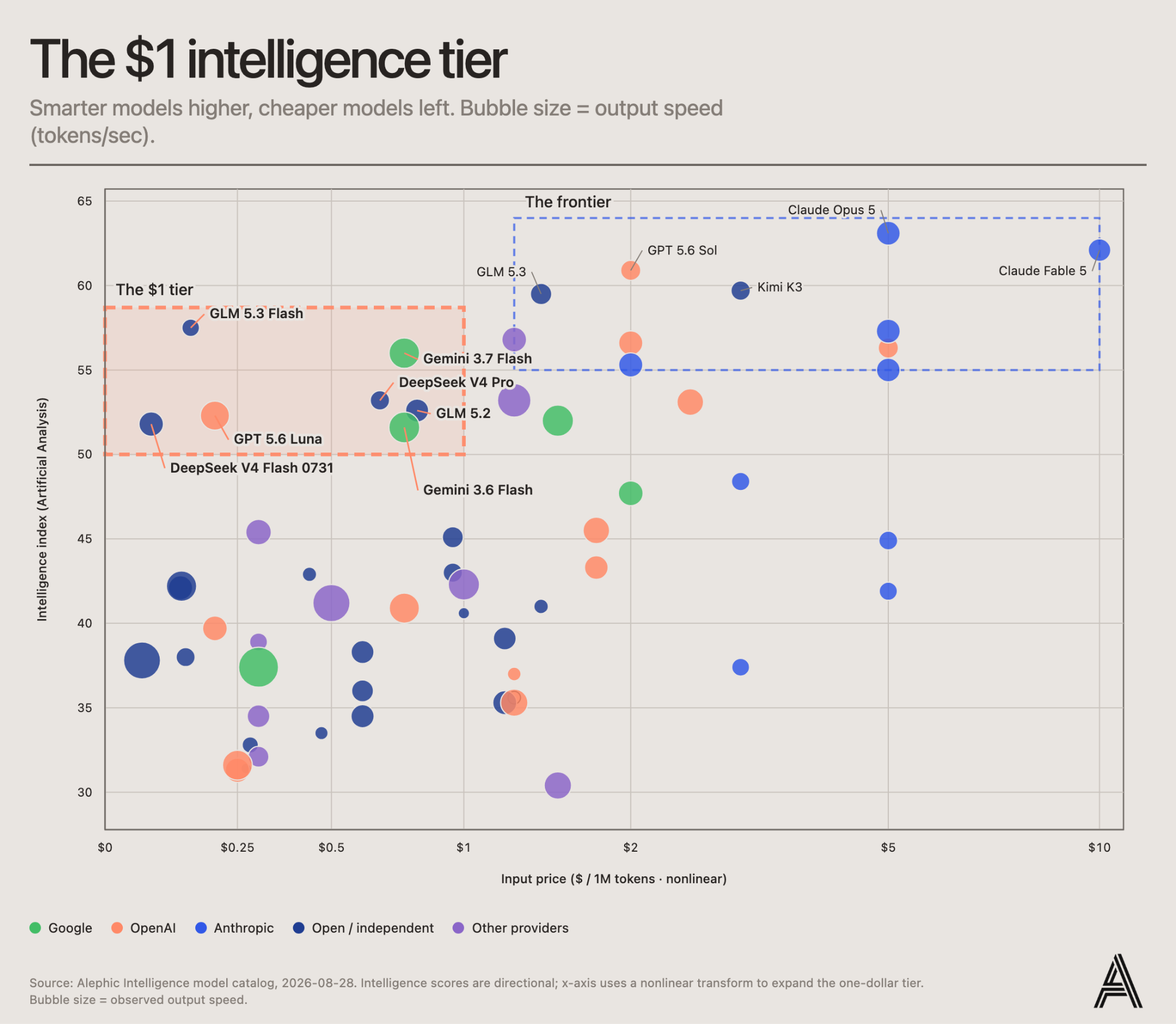
This is the most competitive race in AI by far. Two labs are competing for the true frontier, but at least eight serious entrants exist in this space thanks to Open Source. These are the workhorse models that power the real things happening behind the scenes in agentic systems. At Alephic, we catch every Slack message from our company chat and classify it with Google Flash-Lite, the former leader of this model category. In just the last two weeks, GLM 5.3 Flash and Qwen 3.8 27b have emerged as serious competitors here. When OpenAI dropped the price of Luna by 80% (!!!!) last month, it became the de facto leader here. Back in March, I described this as the $1 sweet spot, where the blended average cost per million tokens was under one dollar.

To Calvin’s point, I also believe this space is about to explode. Most inference shouldn’t be happening on the absolute frontier. Using Fable to reply yes to a scheduling email is, to understate things, not the best use of its capabilities—let alone having it do basic classification tasks like “does this Slack message require further action?” The fact that so few people talk about this mostly indicates that most folks haven’t actually got agents running in production, so their primary experience with these models is through the harnesses, where it’s almost always easiest to leave the smartest model on by default. But as soon as you have to ship a system and you care about cost per task (and speed), you naturally spend time finding the best model at the right intelligence/price point.
Finally, the last vector is the least explored: IQ + cost + speed. In this category, I’m not talking about slightly faster, like going from 200 to 400 tokens/second (toks)—I’m talking about something like what Cerebras has with GPT-OSS 120b, which runs at 3,000 toks at a $0.35/$0.75 cost. This vector is the hardest to nail down because no one has a good intuition for what 3,000 tokens-per-second intelligence might be most useful for. I’ve played with some fun experiments with these models, like building an entire fake e-commerce store that generated pages and products as you searched, but the truly useful places I use these models are on problems where you want to insert AI into user-facing functions without them noticing. The best example is reranking: in our internal company CLI, you can search across calls, contacts, and companies, as well as Google Drive, and GPT-OSS on Cerebras reranks the results against the query as the final step before serving them back to the person/harness. Models at these speeds are still pretty dumb, but that will change, as will our imagination of how to use 3k toks intelligence.
As I said, I’m most interested in the cost + intelligence space, and I suspect the labs will push a lot of resources in that direction as AI maturity continues to grow. I also wouldn’t count out Google quite yet. While they don’t seem to have much momentum in the race for frontier intelligence, their bread and butter has always been squeezing performance-per-dollar out of their models, and I still find myself reaching for flash-lite even as new entrants emerge.

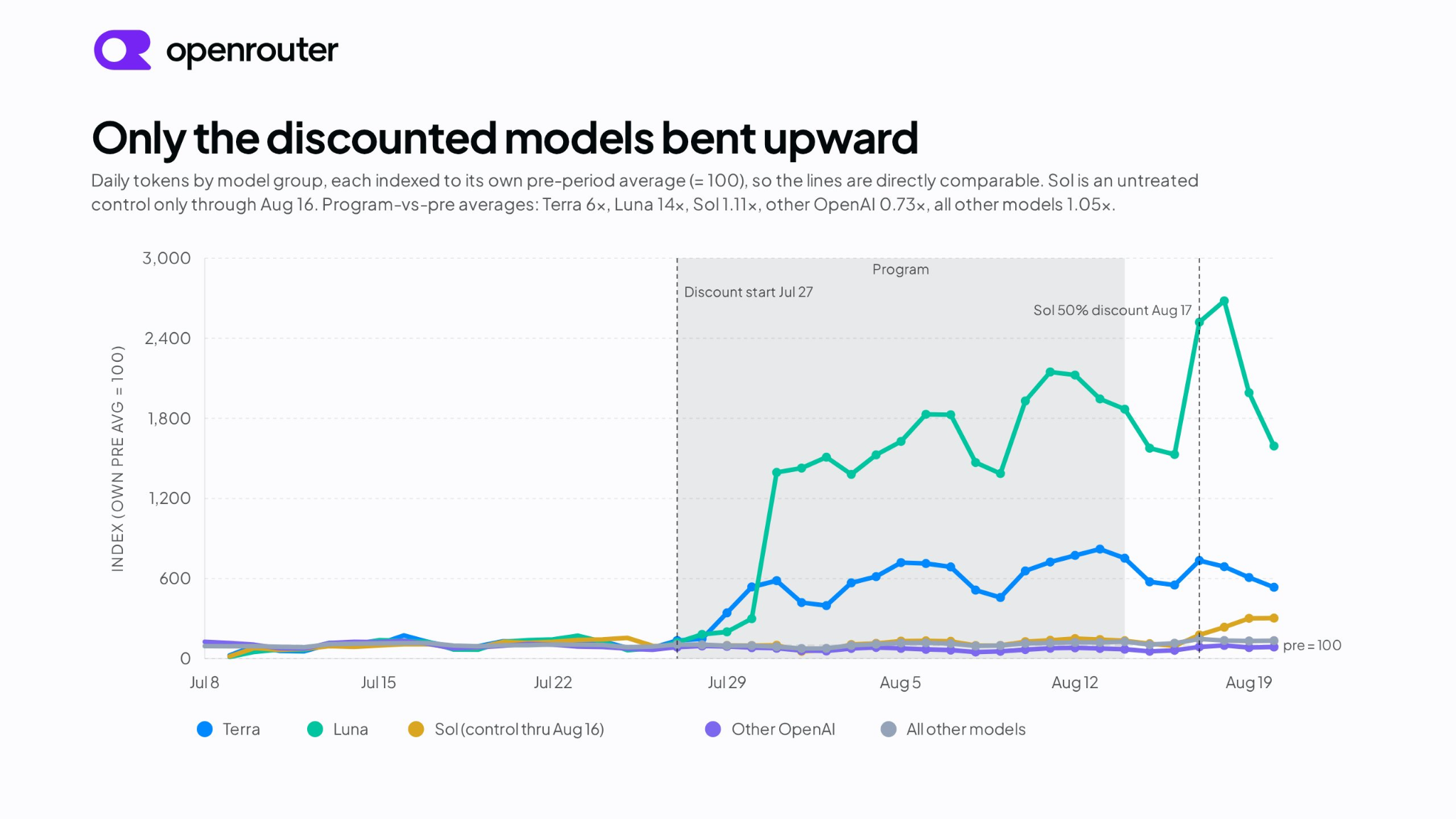
The final point is that as this cost + IQ space gets cheaper and smarter, we’ll see more stories like the one OpenRouter shared last week. When they discounted Luna and Terra they saw an explosion in usage. This is, of course, Jevons Paradox, and I’ve felt it in my own work. As I’ve used Luna more in Codex, I find myself doing many more tasks and a lot of long-running /goal work. If you think there’s a lot of inference now, just wait.
Written by