Enterprise AI Implementation and Deployment
Enterprise AI rarely dies because the model was weak. It dies because the prototype never made it through the org chart and into the real workflow. The hard part is not making the demo work. The hard part is getting the thing deployed where the mess actually lives.
That is why most AI implementation talk feels off. It treats rollout like a checklist that happens after the strategy. Alephic's bias is the opposite: strategy is best communicated as code. Deployment starts the moment you touch a real team, real approvals, real exceptions, and the part of the business that still has to work on Monday morning.
Implementation is what makes the work real
Proof
systems already in the workflow
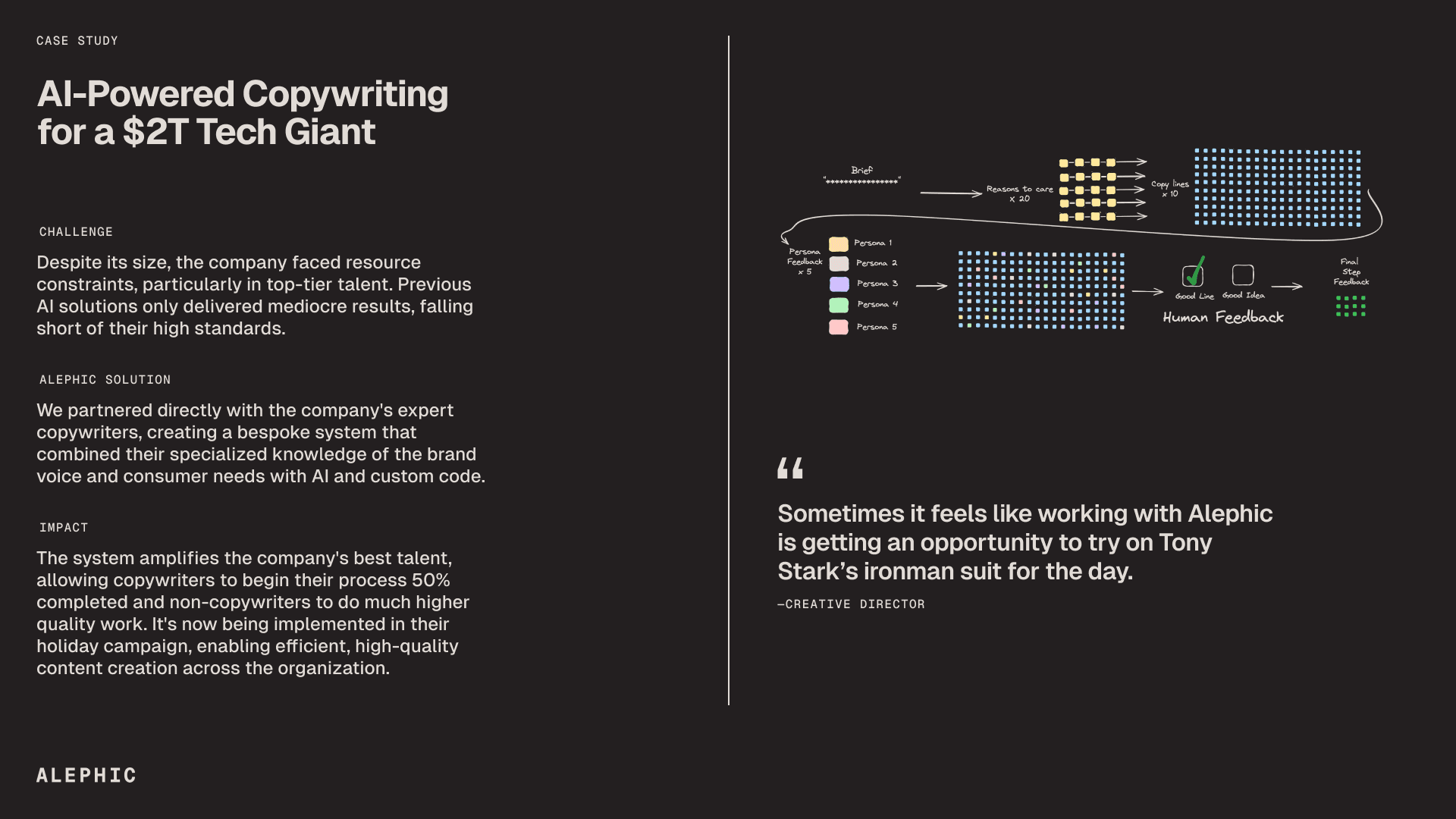
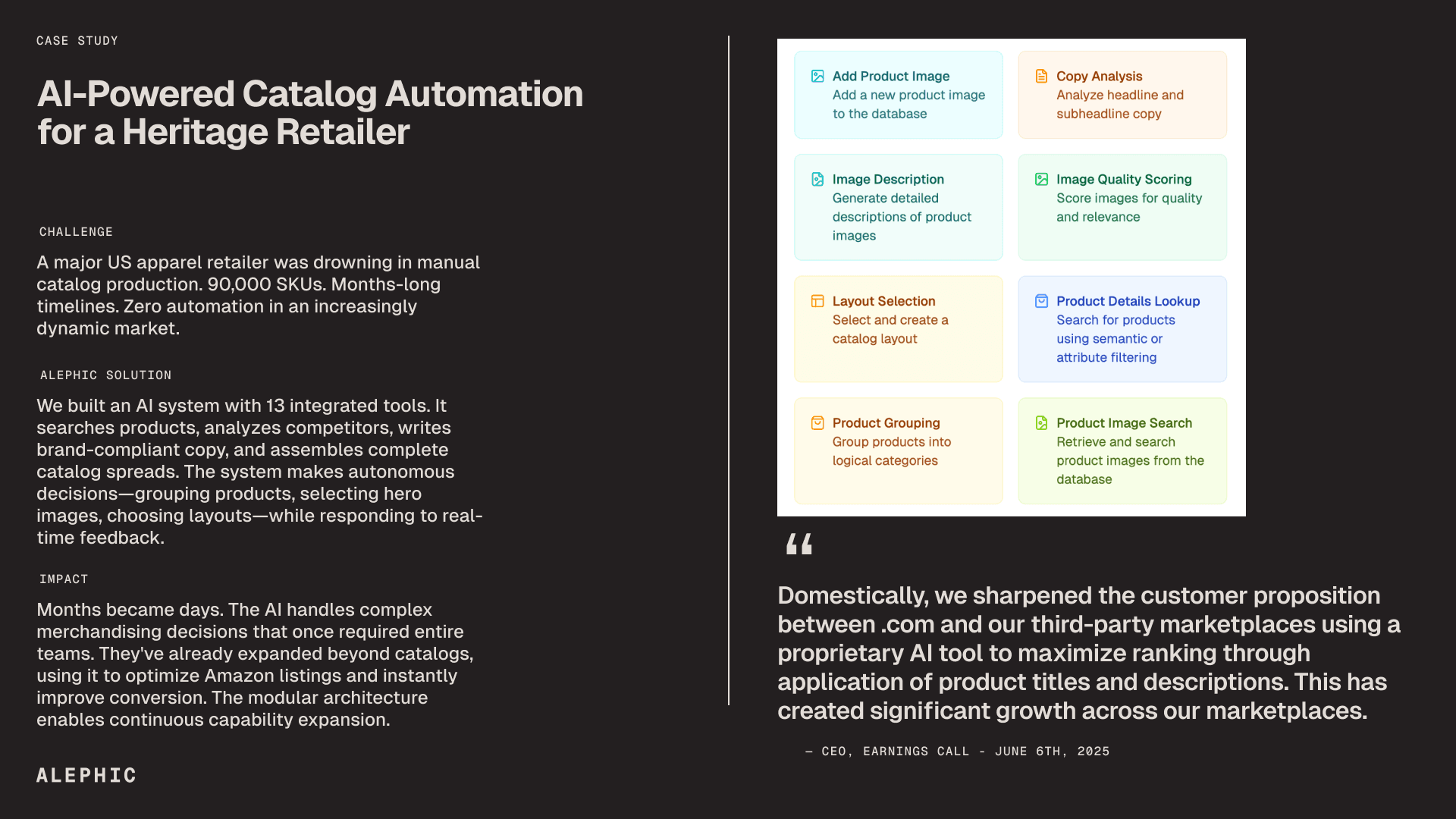
What ships
Systems tied closely enough to the workflow that edge cases show up before the organization retreats to theater.
Real implementation looks like deployed systems, not a tidy stage-gate diagram.
How fast Amazon had something working well enough to beat every SaaS vendor in the room.
How quickly EY moved from pilot to production-grade capability once the work escaped the proof-of-concept stage.
What Amazon compressed when a production system took on the review-scoring work instead of asking humans to grind through it.
Pilot Purgatory
Most enterprise AI implementation work still assumes the hard part is getting permission to start. It is usually the opposite. Getting permission is easy because everybody wants the option value of being able to say they are doing AI. The hard part starts when the prototype has to survive security review, procurement, documentation, training, workflow redesign, and the fifteen tiny exceptions nobody mentioned in the kickoff.
That is how teams wind up in what Erika Chambers called pilot purgatory: lots of proofs, very little production. It is also why so much enterprise implementation content sounds interchangeable. The market keeps treating deployment as the final phase of a project when it is really the whole project.
By that point the problem is usually no longer mostly technical. This is where enterprise teams learn, the hard way, that implementation is often 70 percent cultural and 30 percent technical, not the other way around.
AI finds its value in the nooks and crannies of work. If the system never makes it into those corners, the organization concludes the model was overhyped when the real failure was distance.
If companies invest in AI to change the way they work, most believe it's 70% a technical problem and 30% a cultural one. But our experience shows it's almost always exactly the opposite.
The Word Is Wrong
Implementation sounds like configuration. It sounds like a system already exists and now somebody needs to turn it on. That is not what happens when AI touches judgment. Once a system has to interpret brand language, handle exceptions, and make calls in the flow of work, you are not implementing a tool. You are building an operating loop.
The useful shorthand from inside Alephic is simple: AI, code, and expertise. Miss any one of those and you get a demo, not a deployed system. The model can be excellent and the rollout can still fail because the expertise never made it into the loop or the code never got close enough to the workflow to matter.
Even the word points in a better direction than the market does. In Webster's 1913, deploy means to open out, to unfold, to spread into a wider front. Good AI deployment does exactly that. It unfolds capability into the line of work where decisions are actually getting made.
Which is why this page sits between strategy and context engineering. Strategy decides where the organization is trying to go. Context engineering determines whether the system can think with your actual materials. Implementation is the part where both of those claims have to survive contact with real users.
A PDF cannot do that. A vendor kickoff cannot do that. A committee definitely cannot do that. The only thing that does it is tight iteration in the environment where the work already happens.
How It Ships
Alephic's bias is simple: if the builder is too far away from the workflow, the implementation will get abstracted into status updates. If the builder is inside the workflow, the system can improve at the speed of use. That is the whole point of forward-deployed engineering.
This is also why implementation never stays inside one box on an org chart. It quickly turns into strategy, prototyping, training, and change management all at once. Alephic's S.I.F.T. language captures that better than most vendor rollout frameworks: build to learn, learn to scale, then leave behind something the client can actually own.
- 1
Strategy
Identify the painful workflow, map the private tokens, and align the change with a real business outcome instead of a vague innovation brief.
- 2
Implementation
Prototype and build the first working system fast enough that the real edge cases appear before the organization can retreat to decks.
- 3
Fine-Tune
Refine the behavior with feedback loops, better context, and the exception handling that turns a demo into something trustworthy.
- 4
Transfer
Hand over code, documentation, and operating know-how so the client owns the capability instead of renting it from a vendor or partner.
Proof of Deployment
Beat the vendor bake-off
A three-day prototype beat every SaaS vendor in the room, then turned into production software copywriters could actually use.
Moved past pilot purgatory
EY operationalized a system grounded in private tokens and scaled it across a 250,000-person organization.
Shipped into the workflow
Lands' End turned a transformation idea into working systems operators could steer in real time instead of waiting on a roadmap.
Related Reading
Forward-Deployed Engineering
Why this model exists in the first place: the only way to ship custom AI quickly is to collapse the distance between builder and workflow.
EssayThe Anatomy of a CEO AI Mandate
The clearest executive framing of what AI mandates are really doing inside companies and why the rhetoric matters less than the pattern.
EssayA Framework for Change
The strategy side of rollout: miss vision, plan, team, skills, or incentives and implementation collapses into confusion or resistance.
EssayThe Alephic AI Thesis: 2025
The bigger strategic frame: once AI gets cheap enough to deploy everywhere, organizational velocity becomes the real constraint.
EssayBorrowing Tolerances
A better integration metaphor than vendor implementation theater: working with the tolerances of the real system already in front of you.
Pillar PageNo SaaS
Why software that touches judgment should be shaped around your company instead of being forced into somebody else's schema.
The rollout is the product
If deployment never reaches the nooks and crannies where the work actually happens, enterprise AI implementation turns into governance theater with better demos.
Further Reading
Artificial intelligence implementation: 8 steps for success ↗
IBM on the practical mechanics of AI implementation and why deployment discipline matters after the prototype.
GuideStrategies for Successful AI Adoption and Implementation ↗
Microsoft on the gap between adoption theater and organizational execution.
ResearchUse these 3 MIT guides when implementing AI ↗
MIT Sloan on implementation patterns that survive contact with real organizations.
GuideAI Implementation: 13 Steps to Achieve Success in Your Business ↗
A practical enterprise implementation guide from TechTarget with a strong emphasis on the messy work after the pilot.
Ready to get past the pilot?
We embed senior builders with your team so implementation, deployment, and workflow change happen inside one loop.