Enterprise AI Strategy
Most of what passes for enterprise AI strategy is vendor selection dressed up as vision. Choosing between OpenAI and Anthropic is procurement, not strategy. Real strategy decides which workflows matter, which private tokens have to stay close to the center, and what operating model can actually ship.
That is why the best AI strategy work looks less like a deck and more like system design. Alephic's bias is blunt: strategy is best communicated as code. You are trying to align the people who see what is possible, the builders who can ship it, and the context that lets the system improve after launch. Miss any of those pieces and the mandate degrades into theater.
Strategy is not the memo
Miss one lever
get resistance
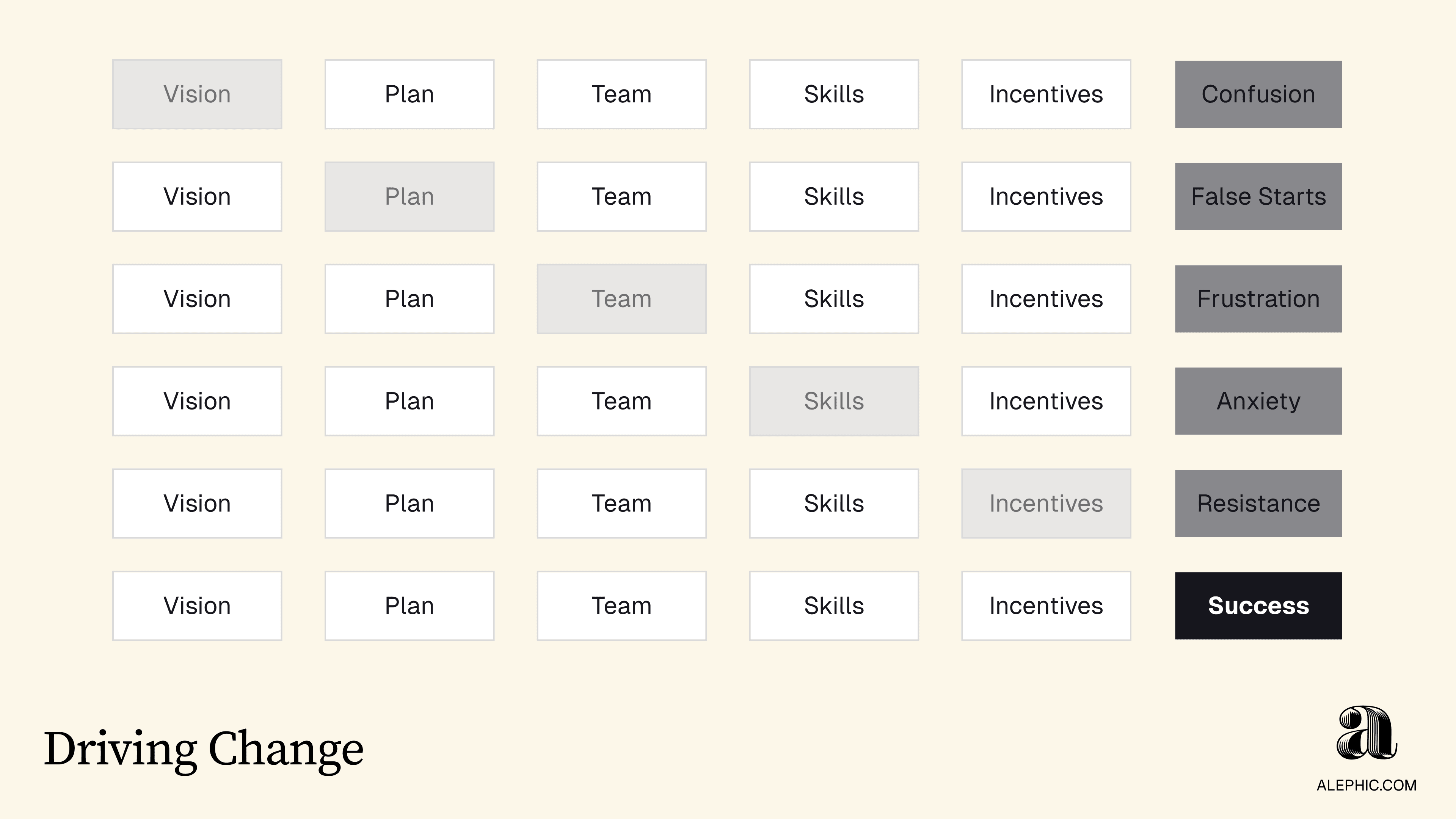
Vision, plan, team, skills, and incentives are not support functions around the strategy. They are the strategy.
The average enterprise stack is already a political system. Strategy has to decide what stays rented and what becomes proprietary.
Vision, plan, team, skills, and incentives. The levers that determine whether the mandate spreads or stalls.
Amazon's builder-ratio target is a reminder that strategy is ultimately a staffing and operating-model decision.
The Memo
The recent wave of CEO AI memos matters, but not for the reason people think. The exact wording is almost beside the point. What matters is that executives are telling their organizations that AI is now the default starting point, not a side project. That changes permission structures. It changes what ambitious people pay attention to. It changes what counts as neglect.
The companies issuing these mandates are not predicting the future. They are creating the organizational muscle memory for navigating it.
But a mandate is still just an opening move. If it never turns into a new operating loop, people learn the wrong lesson. They learn that AI strategy means one more executive slogan floating above unchanged workflows.
That is the real divide between peacocks and executors. The peacock issues a memo and admires the signal. The executor rewrites hiring, approvals, incentives, and defaults so the organization actually behaves differently on Monday morning.
The question is not whether the memo is well written. The question is whether it changes what teams treat as step zero, how quickly builders can move, and what the organization now considers neglect.
The Machinery
James Gross has the best shorthand for this in the repo already: there is the technical trinity, and then there is the machinery of change. The first asks whether you have code, AI, and domain expertise. The second asks whether the organization is arranged to let those capabilities matter.
This is also why the old build-versus-buy question now leaks upward into strategy. Once AI can learn your language, follow your logic, and adapt to your expertise, deciding what should remain a shared SaaS surface and what should become strategic software is not an IT decision anymore.
Most enterprise AI strategy fails by separating those two questions. Strategy teams talk about transformation. Builders talk about systems. Enablement talks about training. Security talks about approvals. Nobody owns the whole circuit, so every function can claim progress while the company itself gets almost none.
Miss one lever and the likely outcome is confusion, false starts, frustration, anxiety, or resistance.
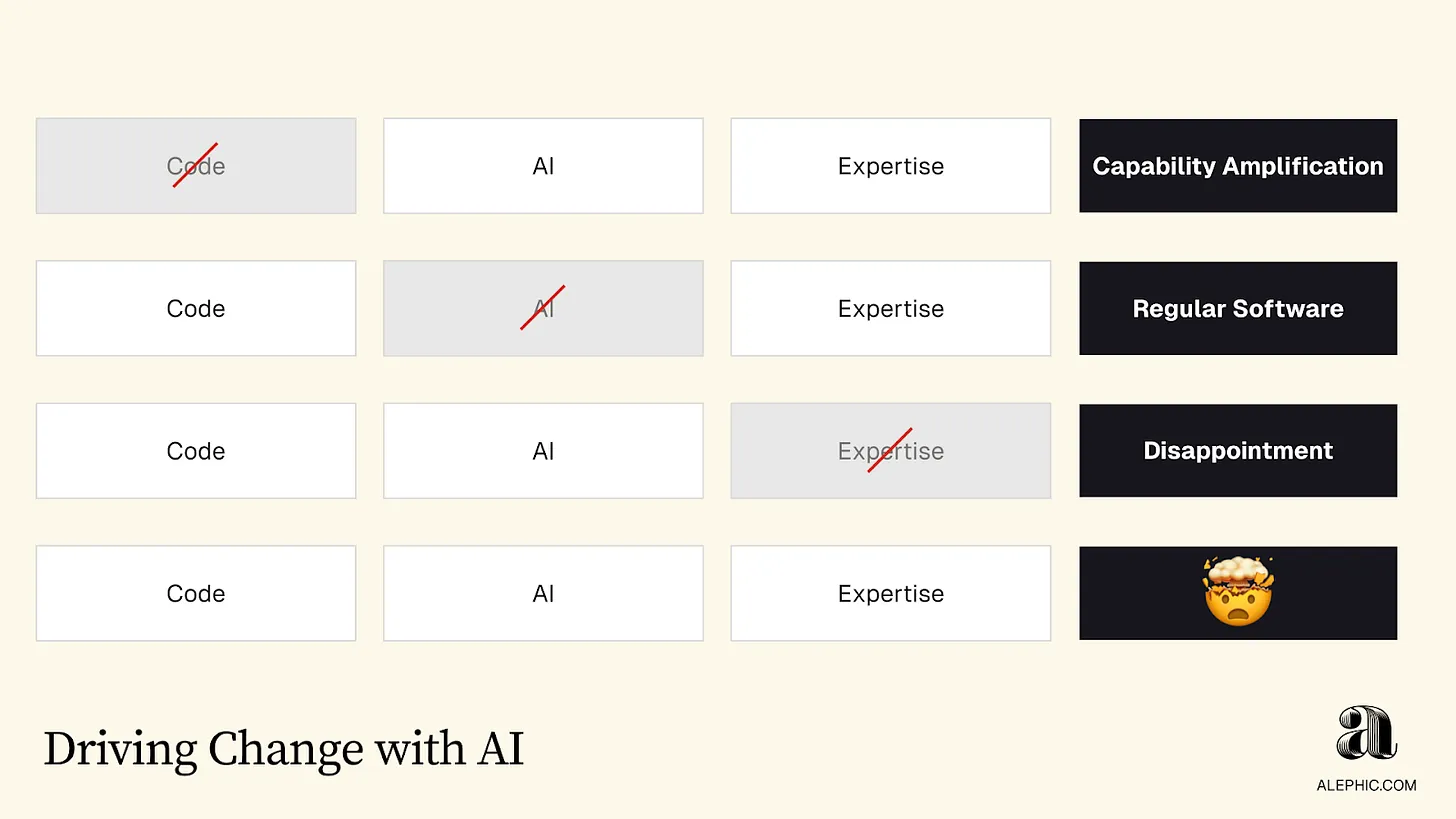
Code, AI, and expertise are necessary. They are still not sufficient on their own.
The Real Enemy
Bad enterprise AI strategy is usually not a thinking problem. It is a bureaucracy problem. The organization has accumulated too many veto points, too many intermediaries, and too much learned helplessness to let the strategy move at the speed of the underlying technology.
That is why bureaucracy is not adjacent to AI strategy. It is central to it. If the org rewards committee fluency more than building fluency, the smartest strategy in the world still degrades into dashboards, steering groups, and an implementation plan nobody can execute.
AI changes the underlying economics because abundance no longer requires standardization. Different systems, data models, and local exceptions can coexist when AI acts as the translator. But that only helps if the organization is willing to remove veto points and put more builders closer to the work.
The binding constraint on AI deployment isn't just physical infrastructure. It's organizational velocity.
The practical consequence is simple: AI strategy should create a shorter path between the people closest to the work and the people who can ship. If it does not, the strategy is cosmetic.
What To Build
The point of enterprise AI strategy is to create a repeatable path from mandate to shipped system. Not one flagship launch. Not one transformation roadshow. A machine that keeps turning ideas, context, and builder time into deployed capability.
That means building for reality, not perfection. AI value does not only appear in giant obvious functions. It appears in the nooks, crannies, and awkward edge cases of the business. Strategy has to be designed for that kind of spread, not for a single hero demo.
Early wins matter here because they fund later bets. Good strategy sequences the work so the first system creates new confidence, new context, and new internal demand for the next one. Bad strategy treats every initiative like an isolated launch and wonders why the organization never compounds.
- 1
Aim at leverage
Choose a painful workflow where better judgment would change the economics of the business, not just the optics.
- 2
Create the loop
Pair domain expertise, AI capability, and code close enough that learning cycles happen in days instead of governance quarters.
- 3
Make the system specific
Feed the loop with context from the actual business, which is why context engineering matters more than another round of model shopping.
- 4
Ship and reinforce
Push the result into live implementation so the organization builds new muscle memory instead of admiring a pilot.
Related Reading
AI Strategy
The plain-language version: what AI strategy is, what it is not, and why vendor selection is not the same thing.
EssayThe Anatomy of a CEO AI Mandate
The clearest articulation of why CEO mandates matter and how to tell theater from real organizational intent.
EssayA Framework for Change
James Gross on the five organizational levers that determine whether AI change compounds or stalls out.
Pillar PageCorporate Bureaucracy
Why most large organizations accidentally sabotage themselves and why AI strategy fails when that operating system stays intact.
EssayThe Alephic AI Thesis: 2025
The broader frame for why AI strategy is now a speed problem as much as a planning problem.
EssayThe SaaS Industrial Complex
Why AI changes the build-versus-buy calculus and why strategy now has to decide which parts of the system stay proprietary.
Pillar PageEnterprise AI Implementation and Deployment
Strategy only becomes real when it gets implemented where the work happens.
Strategy is operating design
Enterprise AI strategy starts working when vision, change, context, and deployment stop belonging to four different committees.
Further Reading
How to Create an Effective AI Strategy ↗
Deloitte on how enterprises frame AI strategy and where the common planning patterns start.
ResearchHow to Build an AI Strategy and Keep It Current ↗
Gartner on keeping enterprise AI strategy current as the market moves faster than the planning cycle.
EssayChange Management for Artificial Intelligence Adoption ↗
Booz Allen on change management as the hidden determinant of AI adoption.
Research5 steps for change management in the gen AI age ↗
McKinsey on why the age of generative AI changes the shape of organizational change work.
Need a strategy that survives contact with the org?
We help leadership teams turn AI ambition into code, operating loops, and systems that can actually spread through the organization.