On AI and Writing
In 2023, I visited a high school in LA to talk about AI. It was the early days of ChatGPT, and mostly I answered questions about how it worked. After speaking with the students, I sat down with an English teacher one-on-one who was worried about what it meant for her and her teaching. My answer, which I've come back to a lot over the years, is that in theory it shouldn't mean anything: her job was never to make great writers out of 15- and 16-year-olds, it was to convince them that learning to write and getting better at it was a worthwhile pursuit. Fully respecting that I'm far out of my depth as a high school teacher, I'd argue that, in theory, AI shouldn't change that job.
Fast forward a few years, and I'm sitting with my fifth grader, helping her do her homework. It's the first time she's being asked to write paragraphs, sometimes more than one. These "write longs" are graded assignments, and she wants to do well. I offer to work with her on it, trying my hardest to find that proper parental line between guidance, advice, and doing the work. Her natural approach is to read the example her teacher provided and try to adhere to it as closely as possible. This makes my advice easy: don't do that. We talk through what the assignment means, and what the example represents, and then I encourage her to just tell me what she'd like to say. After that, I encourage her to write it down.
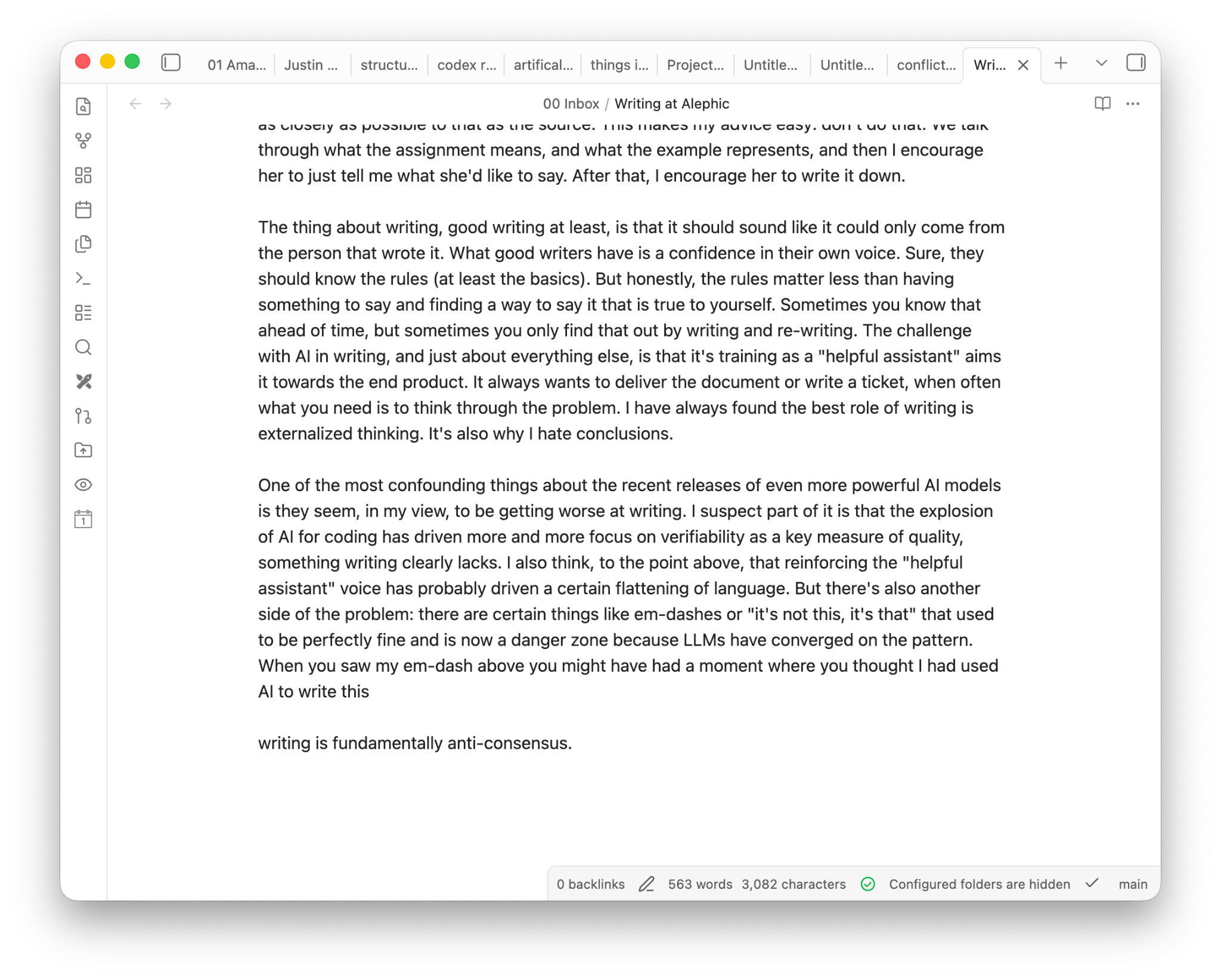
The thing about writing, good writing at least, is that it should sound like it could only come from the person that wrote it. What good writers have is a confidence in their own voice. Sure, they should know the rules—at least the basics. But honestly, the rules matter less than having something to say and finding a way to say it that is true to yourself. Sometimes you know that ahead of time, but sometimes you only find that out by writing and re-writing. The challenge with AI in writing, and just about everything else, is that it's training as a "helpful assistant" and aims it towards the end product. It always wants to deliver the document or write a ticket, when often what you need is to think through the problem. I have always found the best role of writing is externalized thinking. It's also why I hate conclusions.
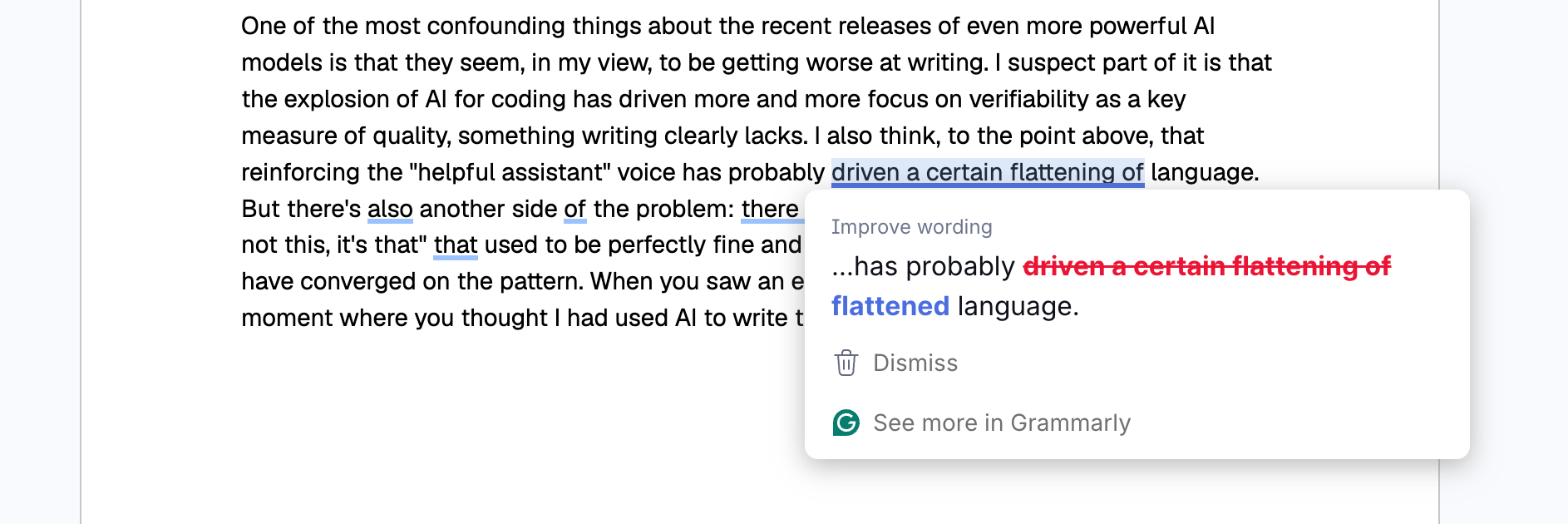
One of the most confounding things about the recent releases of even more powerful AI models is that they seem, in my view, to be getting worse at writing. I suspect part of it is that the explosion of AI for coding has driven more and more focus on verifiability as a key measure of quality, something writing clearly lacks. I also think, to the point above, that reinforcing the "helpful assistant" voice has probably driven a certain flattening of language. But there's also another side of the problem: there are certain things like em dashes or "it's not this, it's that" that used to be perfectly fine and are now a danger zone because LLMs have converged on the pattern. When you saw an em dash above, you might have had a moment where you thought I had used AI to write this (I haven't).
Written by

Alephic Writing
Ideas for building the AI-native enterprise.
New essays on AI, marketing, software, and the organizations being rebuilt around them.